Understanding the bigger picture: How SaverLife is building a holistic model for personalized financial guidance


This work was funded by JPMorganChase. We thank them for their support and acknowledge that the findings and conclusions presented in this report are those of SaverLife alone and do not necessarily reflect the opinions of JPMorganChase.
Recognizing and responding to the unique and changing financial lives of our members
Meaningful financial health solutions start with a fuller understanding of people’s lives. That means looking beyond any single data point and bringing together what people say, do, and experience in real time with the broader forces shaping their financial lives. Through the work we’ve done with support from JPMorganChase, we showcase how SaverLife combines technology and multiple forms of data to better understand common financial challenges our members face and respond with more personalized, timely, and effective support.

Understanding and responding to personal financial situations
For millions of people who are living on low- to moderate-incomes, financial life is not a series of stable, predictable decisions. It is often dynamic, volatile, and highly complex.
People are managing multiple financial goals, navigating overlapping challenges, and responding to financial shocks in real time. Yet many financial health solutions are built on static, incomplete snapshots of the people they’re meant to serve, offering generic guidance that relies on singular data points and fails to reflect the complexity and interconnectedness of people’s lives.
This mismatch has consequences. When solutions are built on limited data, whether a one-time survey, a credit score, or a single transaction feed, they miss critical context. The result is one-size-fits-all interventions that ask too much of people, arrive at the wrong time, or do not address the barriers that matter most.
Meaningful financial health solutions require a more complete understanding of people’s lives, one that brings together not only what people say, what they do, and what they are experiencing in real time, but also the broader contexts that shape those experiences. This means integrating individual insights gleaned from behavioral and self-reported data with contextual information such as local conditions, economic trends, and evolving policy landscapes.
No single data source can provide this level of understanding. But when combined thoughtfully, these data sources can create a more holistic, human-centered picture, one that enables support that is relevant, timely, and actionable. Our goal is not to reduce members to data profiles, but to use multiple forms of information to better understand and respond to their unique and changing realities.
The following examples illustrate how SaverLife combines multiple forms of data to better understand common financial challenges our members face and respond with more personalized, timely, and effective support. By using technology to connect these insights, we are able to deliver tailored guidance and interventions that engage members now so they can ultimately make progress toward greater financial stability and long-term financial health — both individually and at scale.
OnboardingData signals used:
- Self-reported survey data
- Member-selected financial goals
- Reported financial challenges and barriers
- Real-time behavioral data
- Engagement patterns in the product showing drop-off or lack of progress on financial goals
- Contextual data
- Established literature on goal conflict
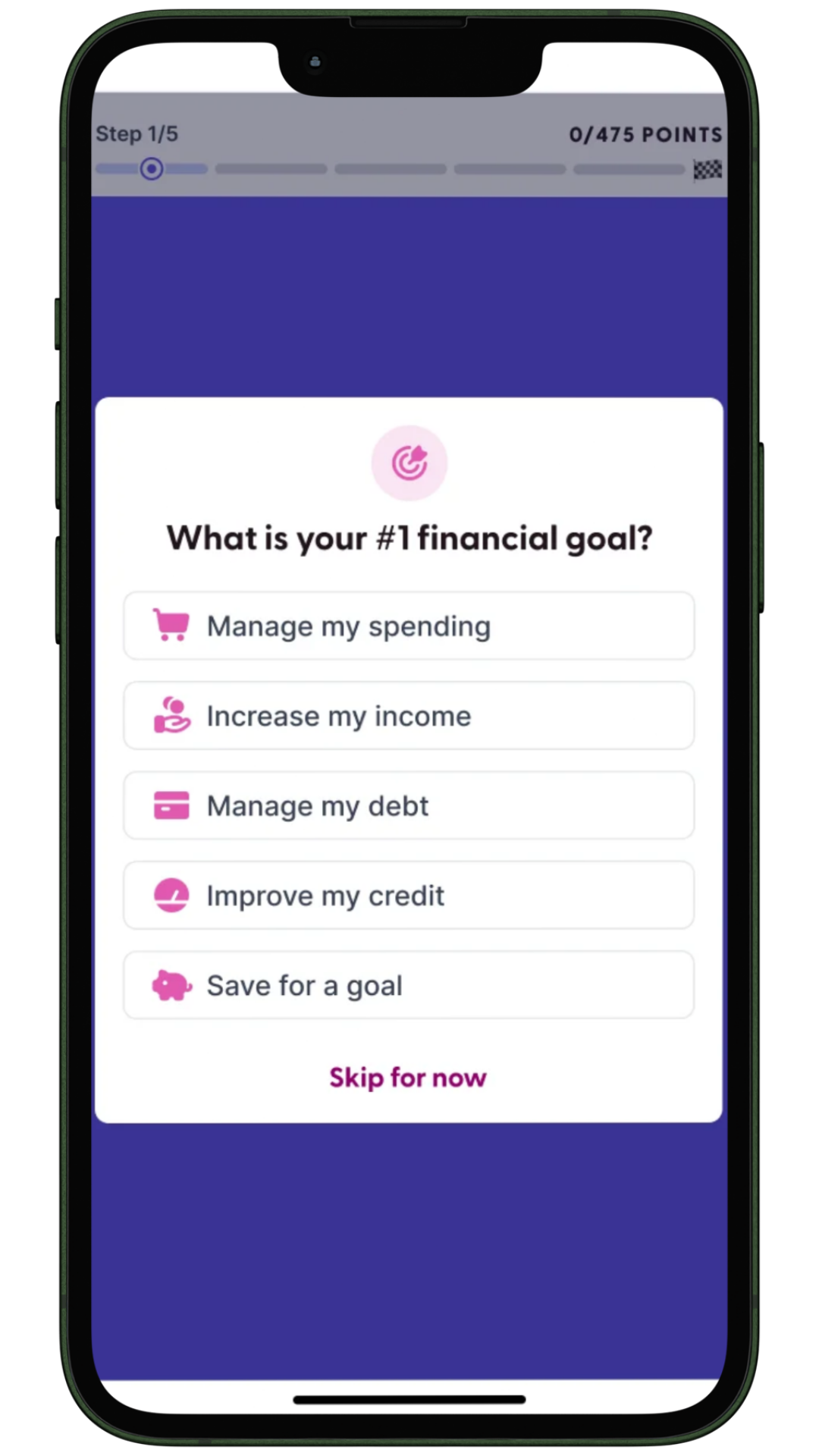
The challenge: Members often come to SaverLife with multiple financial goals at once — saving money, paying down debt, increasing income, building credit, or covering everyday expenses. While this ambition reflects a strong desire for financial stability, trying to tackle too many priorities simultaneously can make progress feel overwhelming and difficult to sustain.
Between April and June 2025, we surveyed members in Georgia, Alabama, and the DMV area about their financial goals and challenges. We found that members selected an average of 6.9 goals out of 9 possible priorities, depending on the region. At the same time, behavioral and engagement data showed patterns of drop-off or stalled progress among members trying to pursue multiple goals simultaneously.
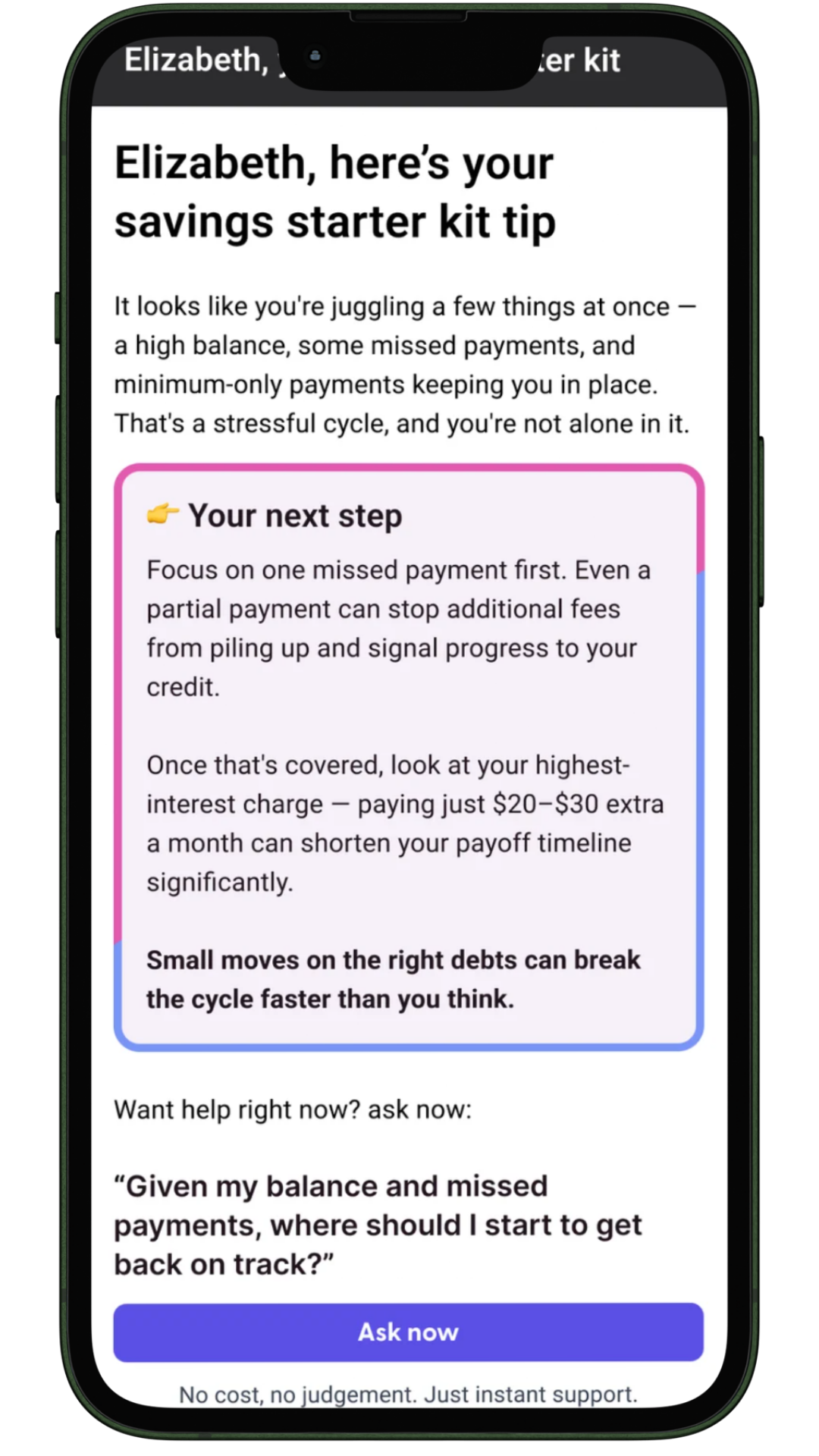
What SaverLife changed: By combining behavioral signals with self-reported survey data and contextual insights, we identified an opportunity to simplify the onboarding experience to deepen engagement through enhanced personalization.
Building from research that suggests incremental progress can reinforce positive financial habits over time,,, we redesigned onboarding to help members prioritize a single financial goal rather than giving the option to select multiple goals at once. The updated experience introduced clearer progress pathways, reduced cognitive overload, and enabled more targeted interventions aligned with each member’s stated priorities and observed behaviors.
Outcome: Through this effort, SaverLife saw a 50% increase in the rate of members who linked their bank accounts and nearly doubled the percent of members who shared additional self-reported information to build a more complete financial health profile. Having a more complete picture creates more opportunities for personalization, setting in motion a virtuous cycle where every interaction helps us deliver even more relevant support.
Why this matters: This work demonstrates that better personalization begins with mindful data collection practices. Instead of overwhelming members with competing priorities, restrained, targeted data collection approaches can actually encourage integrated data systems with a richer set of inputs that can be leveraged to help identify the most meaningful next step.
Just as importantly, this reframes onboarding from a one-time data collection exercise into the beginning of a trusted relationship. As members choose to share more over time, organizations can build a richer understanding of their financial lives, enabling guidance that becomes increasingly personalized, relevant, and effective.
Rapid response + crisis supportData types used:
- Real-time/near real-time data
- Timing of financial stress events
- Contextual data
- Policy tracking
- Location (zip code, region)
The challenge: Financial crises do not unfold in a single moment, and effective support cannot either. Economic shocks and policy disruptions such as interruptions to public benefits, can rapidly destabilize household finances, particularly for families already living on tight margins.
Traditional survey-based approaches provide valuable insights, but they often struggle to capture the rapid changes that can occur in a household’s financial circumstances. As a result, important shifts in need may go undetected until after a period of financial stress has already begun.
What SaverLife is doing: SaverLife built a rapid response infrastructure designed to identify emerging financial risks and respond quickly as conditions evolve.
By layering real-time events and shifting policies — like the government shutdown in 2025 that resulted in changes in benefit income, we can better understand which members are most likely to be affected and what forms of support may be most useful in the moment.
This integrated approach allows us to move beyond broad, one-size-fits-all outreach and instead deliver targeted interventions tailored to members’ immediate circumstances. Using early warning signals and indicators of financial stress like spending exceeding income, zero balance events, and negative income shocks, we can proactively deliver in-product guidance, share relevant resources, provide personalized outreach, and distribute timely financial information that helps members navigate uncertainty.
Through initiatives like our Emergency Response Fund, we can also rapidly deploy direct cash assistance to eligible members facing acute hardship.
Impact and outcomes: Member feedback reinforced the importance of timely, responsive support during moments of financial instability and uncertainty, with one member sharing:
Through this effort, SaverLife:
- Distributed more than $85,000 in emergency cash assistance
- Supported approximately 1,700 members during the SNAP disruption and government shutdown
- Delivered timely information about food assistance resources and financial support programs
- Generated more than 116,000 outreach opens and 3,400 clicks through targeted campaigns and proactive messaging
- Created a real-time feedback loop that helped identify emerging financial stress signals and evolving member needs
Why this matters: This work demonstrates how integrated data ecosystems can support dynamic, real-time interventions rather than static or one-time support models. By continuously monitoring changing economic conditions, policy disruptions, and member stress signals, we can adapt support strategies over time and better meet members where they are as their financial realities evolve.
Financial Health NavigatorData types used:
- Self-reported data
- Debt type, goals, financial concerns
- Real-time behavioral data
- User interaction with the tool (what they click, explore)
- Transactional data showing balance sheet
- Contextual data
- Geographic information
- Financial content from SaverLife website
The challenge: Financial challenges rarely exist in isolation. Debt, income, expenses, and access to resources are deeply interconnected, yet many financial tools still rely on static snapshots and generic advice that fail to reflect the complexity of people’s real financial lives. Members often need guidance that adapts to their specific circumstances, behaviors, and goals rather than one-size-fits-all recommendations delivered without context.
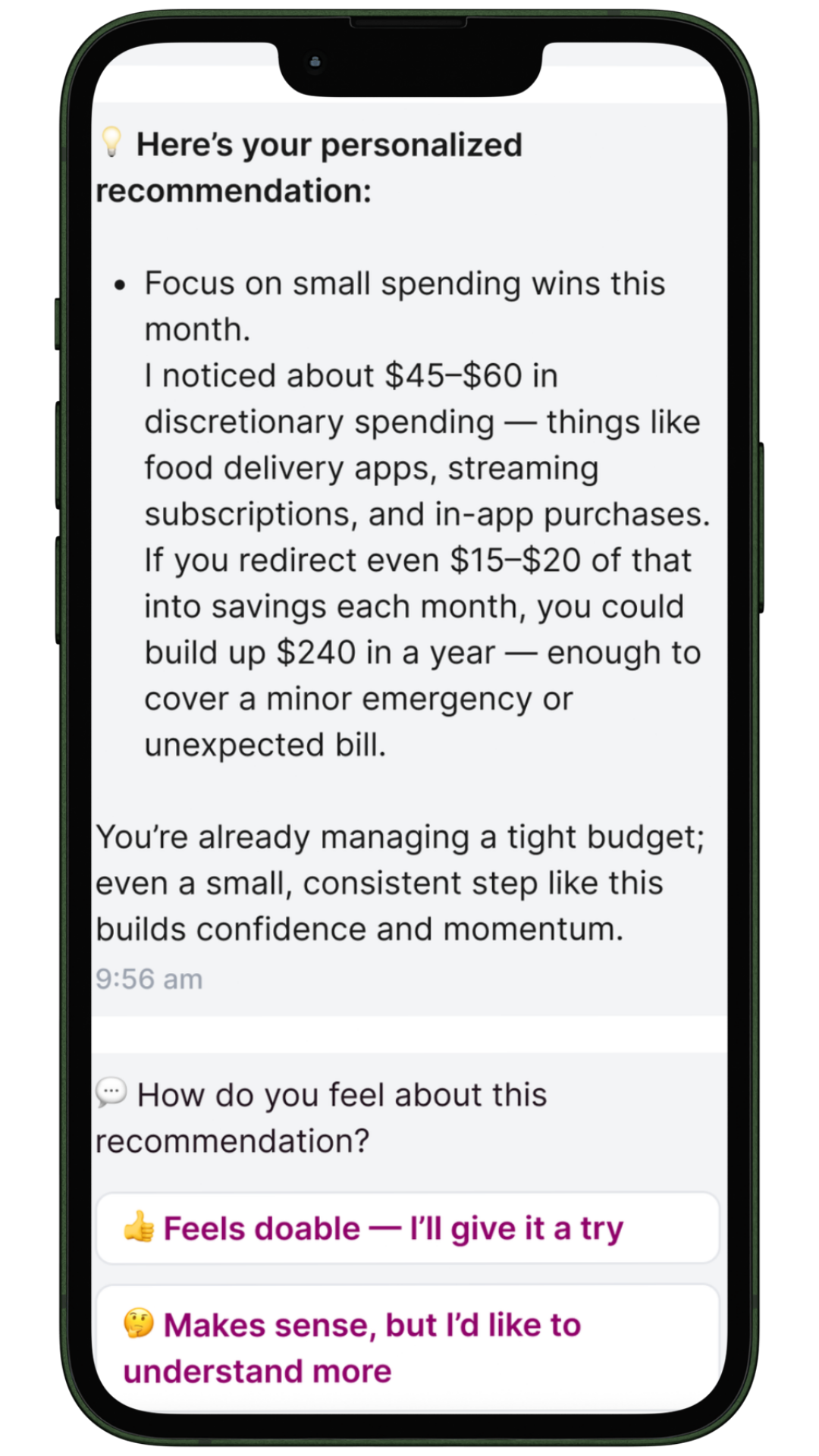
What SaverLife is doing: SaverLife built the Financial Health Navigator to help members turn complex financial situations into clearer, more achievable next steps. Using AI, the Navigator synthesizes self-reported, behavioral, and geographic data to develop a more complete understanding of each member’s financial situation and needs over time. By analyzing how members engage with the platform, the goals they identify, and the financial pressures they report, the Navigator delivers tailored, actionable guidance focused on the next step most relevant to each member.
The tool currently powers personalized interventions related to debt management, savings recommendations, and financial goal progression, creating a more responsive and individualized experience than traditional financial education tools.
Impact and outcomes: These early engagement signals suggest that members are more responsive to contextual, in-product guidance tailored to their real financial situations. The Financial Health Navigator is available to more than 290,000 SaverLife members.
- More than 63,000 members have viewed the experience
- More than 12,000 members have engaged in conversations with the Navigator
- More than 50% have sent multiple messages
- Members who chat with the Navigator are 3.5 times as likely to return to the platform in the following month than baseline monthly returns
- Participants in our debt diagnostic were 10x more likely to act on a recommendation to talk to a debt counselor compared to traditional encouragement methods like email.
Why this matters: This work demonstrates how AI and integrated data systems can move beyond static financial snapshots to deliver personalized guidance that adapts to the complexity of people’s lives. By combining multiple forms of data into a more holistic understanding of each member, we can create clearer, more actionable pathways toward financial stability.
Building a more human understanding of financial lives
No single dataset, model, or signal can ever fully capture the complexity of someone’s financial life. People’s experiences are constantly evolving, shaped by changing economic conditions, family responsibilities, policy decisions, unexpected crises, and personal goals that often shift over time. But that reality makes it even more important to build a holistic, human-centered understanding of members — and to know which kinds of data are most useful in different moments. The real challenge is not simply collecting more data, but combining the right data at the right time to create a fuller picture and better support meaningful progress.
At SaverLife, we believe meaningful financial support requires bringing together multiple forms of data, including real-time behavioral, transactional, geographic, qualitative, and self-reported information, while continuously listening to and learning from the people we serve. No single source can fully capture the realities of people’s financial lives. The most valuable insights emerge when individual experiences are understood alongside the broader economic, community, and policy contexts that shape them. By combining these perspectives with ongoing member engagement and feedback, we can better understand changing needs and deliver support that is relevant, timely, and actionable.
This work is ultimately about more than personalization or technology. It is about building systems that are responsive to real people, capable of adapting as needs evolve, and grounded in the belief that solutions are only effective when they reflect the realities of the individuals and communities they are designed to support.
This work was funded by JPMorganChase. We thank them for their support and acknowledge that the findings and conclusions presented in this report are those of SaverLife alone and do not necessarily reflect the opinions of JPMorganChase.