Back to Research Library and Insights
As energy costs rise, how we offer solutions matters
Clear information, relatable stories, and simple visuals can help households understand the financial trade-offs.

Rising energy costs are driving interest in clean energy solutions
Energy costs are rising quickly, and for SaverLife members that increase is more than an inconvenience – it is a source of financial strain that threatens to break the balance sheet. Through SaverLife’s Downpour initiative, 80% of respondents report higher energy bills in the past year. Nearly half (48%) are energy burdened, meaning they spend more than 6% of their income on gas, electricity, and other energy costs. For families already managing tight margins, that shift can destabilize carefully balanced budgets.
It’s not surprising, then, that many members express interest in clean energy upgrades that promise lower monthly bills. Energy-efficient appliances, weatherization improvements, and other upgrades are often framed as financial relief strategies. But interest doesn’t always translate into action. And as with many financial decisions, the path from awareness to interest to follow-through is not a straight line.
Over the past two years, SaverLife tested a simple question: What actually motivates low- and moderate-income households to engage with (and seriously consider) clean energy solutions?
First, the baseline signal is clear: climate and energy content consistently outperformed other topics on our platform. Members are paying attention to rising costs and are actively seeking information that might help them manage them. There is genuine demand for practical guidance.
But how that guidance is delivered matters.
In a series of in-platform pilots reaching more than 85,000 members, we explored different formats for presenting clean energy information, comparing against our baseline engagement rates for our traditional blog-style articles. We then introduced informational videos, infographic-style posts, and member stories, along with some random variations in how the content was promoted.
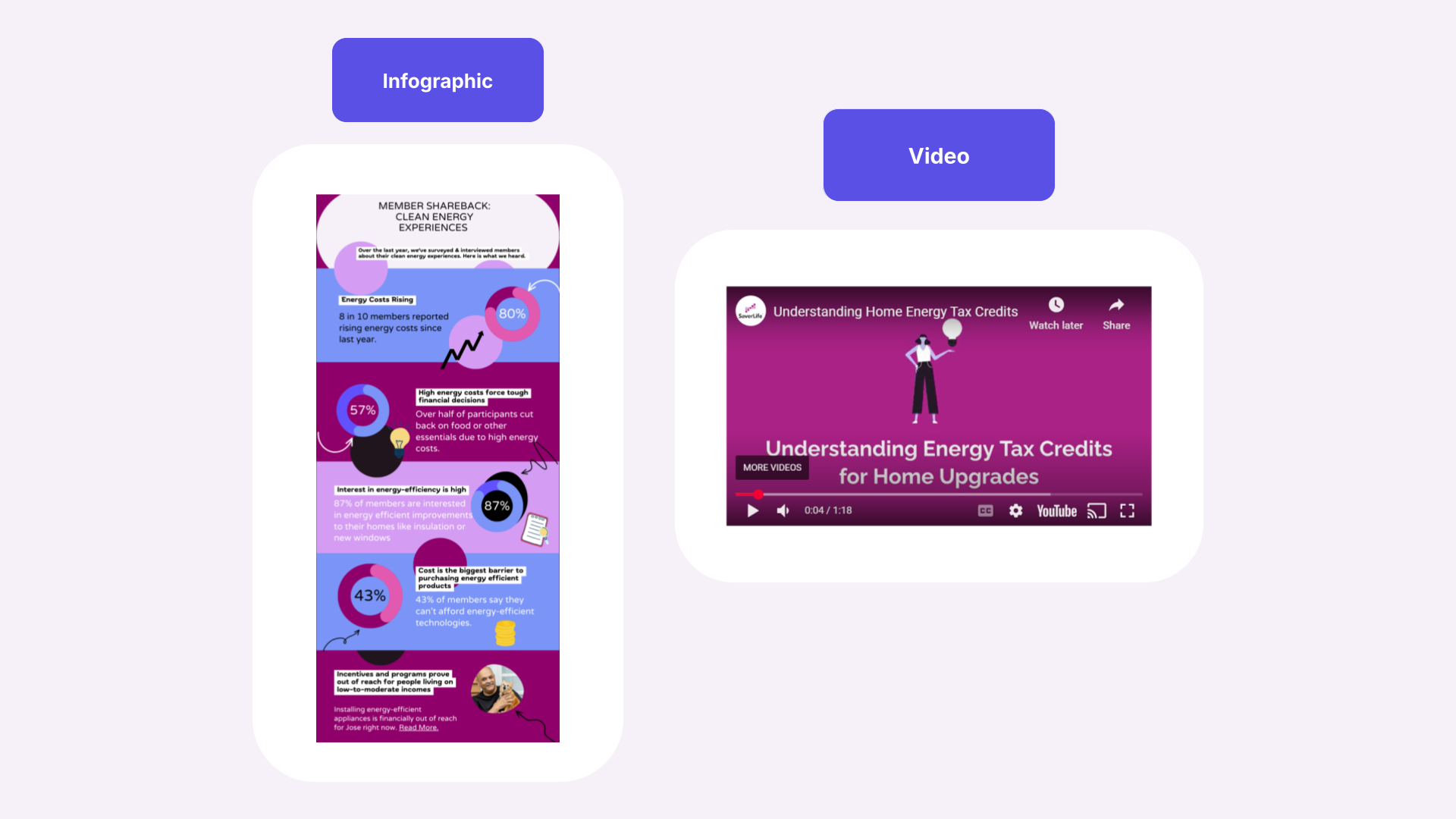
The differences were meaningful. Infographics had 34% more views than informational videos covering similar material. Content that was visual and scannable appeared to lower the barrier to engagement with what can otherwise feel like complex or technical information.
Even more striking, when a member story was paired with a clear, data-driven infographic, engagement was 360% higher than the same story without the accompanying infographic. The story itself did not change; the context changed. Relatable narratives resonated even more when grounded in concrete numbers and clear, actionable explanations.
At the same time, we wanted to understand the role of common financial incentives more directly. Is cost alone a prohibitive factor? In our 2024 Energy Cost Burden Survey, more than 800 members were randomly shown one of three scenarios describing an energy-efficient appliance with a rebate of either 25%, 50%, or 75%. We then asked how likely they would be to make the purchase, even if they didn’t need a new appliance right now.
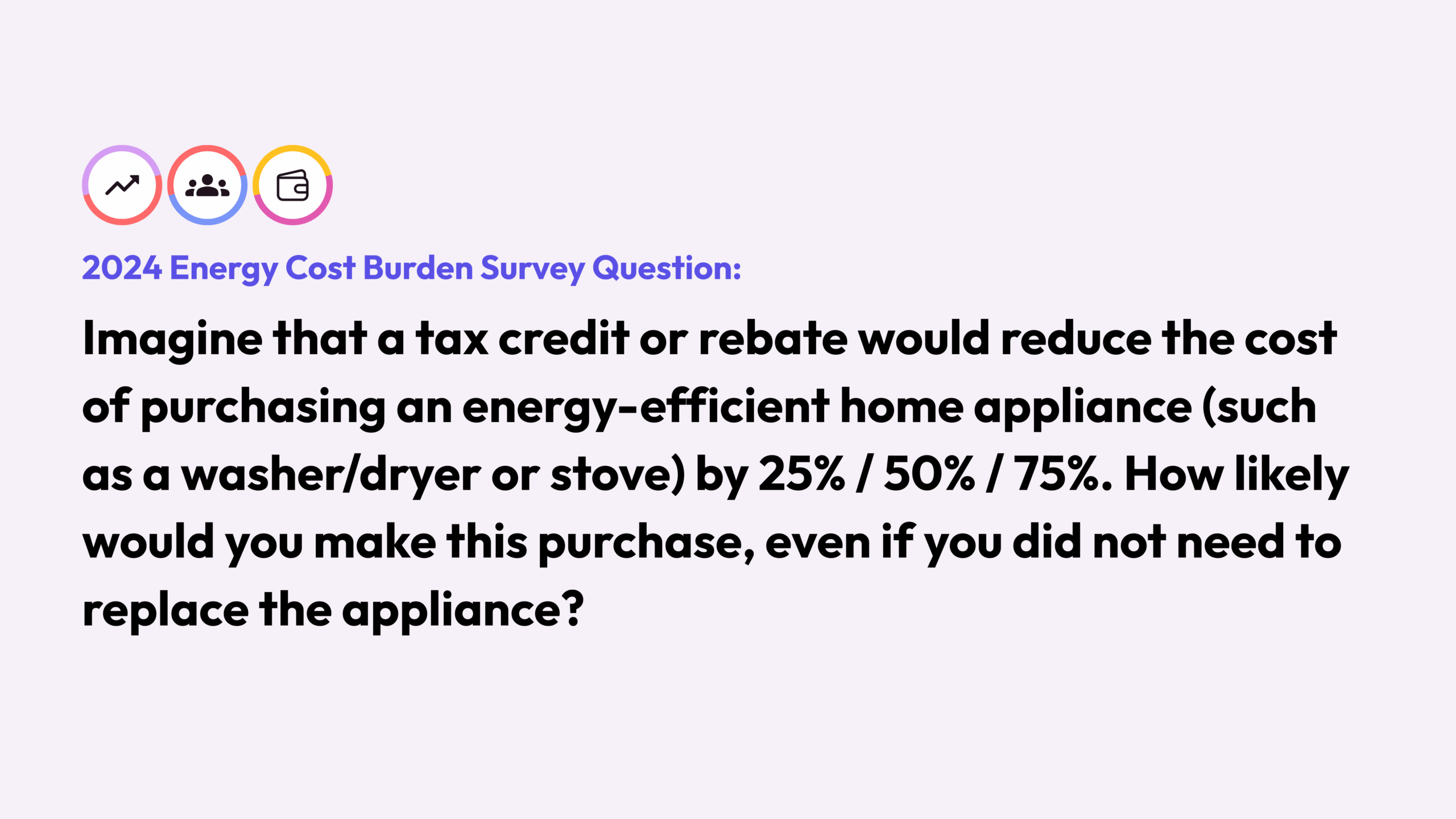
As expected, larger rebates increased stated interest, but not by much. While 61% reported they would likely purchase the appliance with a 25% rebate, it only rose to 65% with a 50% rebate and 69% with a 75% rebate. Tripling the size of the rebate only moved 8% more of respondents into the likely category. This also means that even at the highest rebate level, nearly one-third of households remained unsure or unlikely to act.
This suggests that while affordability is necessary, it is not sufficient. Classic incentives, like rebates, can reduce price barriers, but other barriers remain. Clean energy decisions are not purely economic calculations. For many households, they are risk assessments shaped by uncertainty: Will the savings materialize? What if something breaks? Is the upfront cost manageable, even with a rebate? Is this information trustworthy?
Taken together, these findings point to a broader lesson. Expanding access to clean energy solutions for low- and moderate-income households will require increasing subsidy levels, but that is not enough. It will require examining not just the amount of the subsidies, but also the structure of those subsidies: as a rebate, as a discount, as a tax credit. Similarly, it will require attention to how information is structured, who delivers it, and whether it supports households in making sense of complex trade-offs.
Clear, plain-language explanations; visual tools that simplify comparisons; stories that reflect lived experience, paired with transparent data. These are not superficial messaging choices. They shape whether households feel equipped to evaluate an option that may affect their finances for years.
As energy costs continue to rise, households are looking for solutions. Meeting that moment will require aligning financial support with communication strategies that build clarity and trust – not just knowledge.
At SaverLife, our product and research teams work in close alignment to surface insights that help us better understand and serve our members.
Our member experience team continuously evaluates campaign performance to shape content and experiences that are member-first and meaningful, while our research team conducts surveys to understand how members are faring and to inform policy recommendations.