Back to Research Library and Insights
Rethinking how we support people with debt
Through our Credit Conundrum initiative, we found that the barriers our members face are not just financial or informational. They are emotional, behavioral, and structural as well.

We know through surveys, transactional data, and conversations that SaverLife members are actively working to manage their debt. They are cutting back, juggling bills, and trying to make progress where they can. Our research sought to better understand what stands between people’s intention to address their debt and their ability to take meaningful action.
Many debt solutions are built on the assumption that awareness leads to action. But through our Credit Conundrum initiative, our research suggests the reality is far more complicated. Through interviews, surveys, and large-scale interventions, we found that the barriers our members face are not just financial or informational. They are emotional, behavioral, and structural as well.
Debt is not just financial. It’s emotional.
When people talk about debt, they rarely start with numbers. Instead, they describe how it feels: overwhelming, stressful, and constantly present in the background of daily life. Those feelings shape how people weigh risk, evaluate options, and decide whether taking action feels safe or worthwhile. In that context, hesitation is not necessarily disengagement. Often, it is a response to uncertainty and pressure.
Even when people are aware of solutions, many do not use them. In our research, three-quarters of our surveyed members had heard of options like debt consolidation or credit counseling.* But awareness did not translate into action. Members often described uncertainty about how these services work, concerns about scams or hidden fees, confusion between different options, and a belief that their situation was not yet serious enough to seek help. As a Missouri member expressed, “I always felt kind of leery of debt management plans. I see them as advertisements, and I don’t know if I trust them.”
Taken together, these concerns create a trust gap where the path forward may exist, but it does not feel safe, trustworthy, or straightforward enough to take.
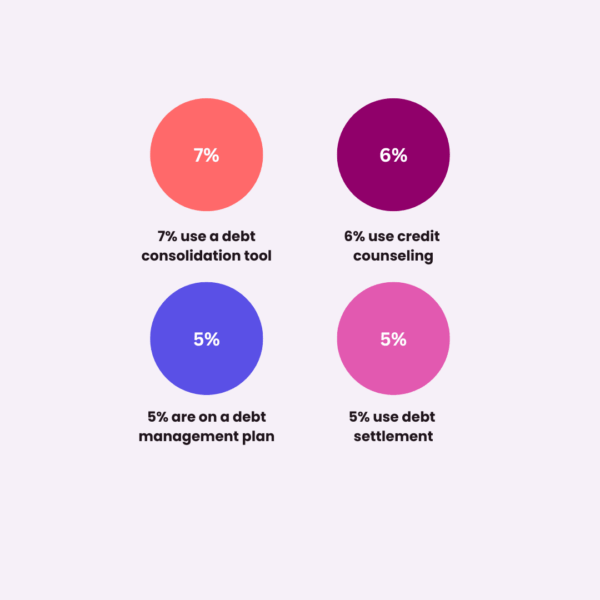
- 73% of SaverLife members were aware of these different debt management products, but use of these products is strikingly low.
- Distrust is the top reason members are not interested in these tools, with 33% of SaverLife members responding, “I do not trust organizations that offer these debt management tools.”
Rethinking the problem
What emerges from this work is a different way of understanding the challenge of managing debt. The problem is not that people are not acting, but that the system makes meaningful progress difficult. People are navigating emotional stress, unclear options, and competing priorities, all at once. And having high financial stress can trigger the Ostrich Effect, a cognitive bias in which people intentionally avoid seeking help, believing that ignoring negative or uncomfortable information will lessen stress. Heightened emotional stress can also alter brain chemistry and impede cognitive function, leading people to make decisions in real time, often with limited room for error.
If we want to support better outcomes, we need to move beyond the assumption that more information will lead to action. And shift to understanding how people actually experience debt and design solutions that reflect that reality. The challenge is not convincing people to care about their debt. Most already do. The challenge is building systems, tools, and support that make meaningful action feel possible within the realities of people’s lives.
*SaverLife fielded a survey to 1,463 SaverLife member panelists between March and September 2025 to to understand members’ experiences managing debt and how this relates to their financial circumstances.